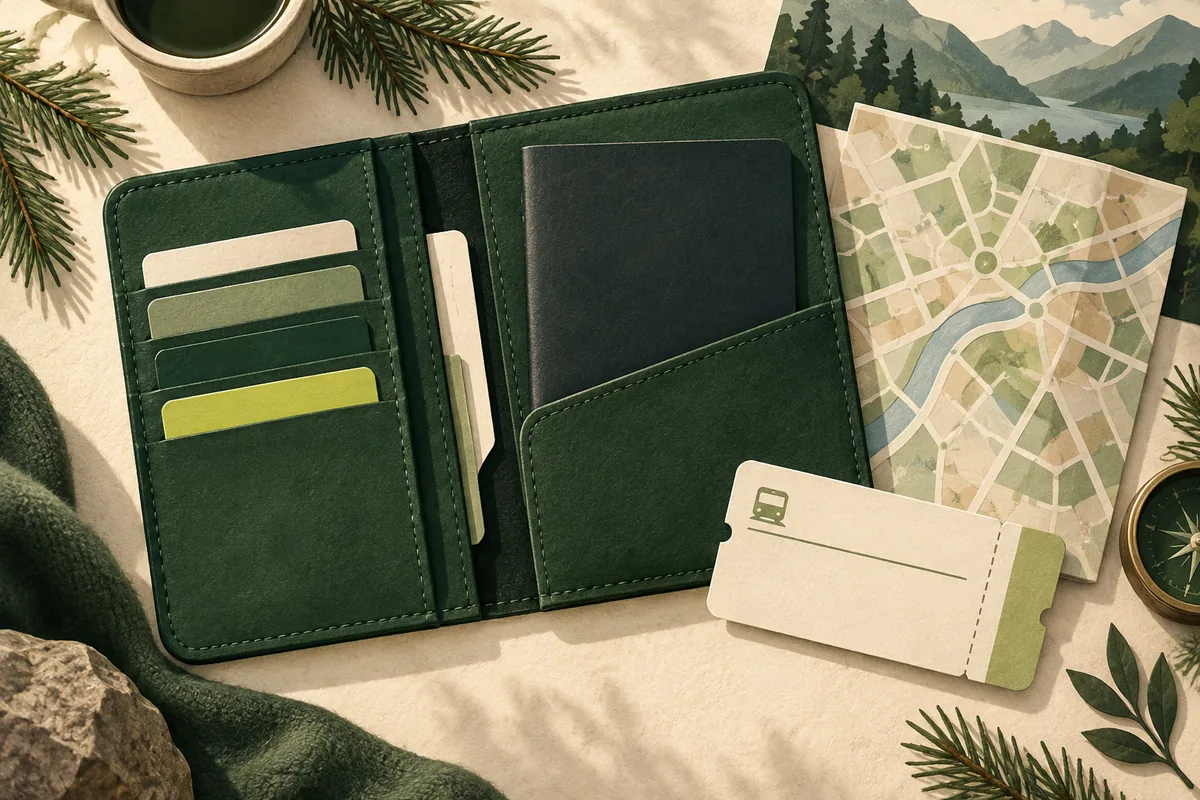
The best travel wallets make the dull parts of a trip easier. Your passport stays flat. Your cards have a home. The cash for today's train ride does not get mixed up with last week's receipts.
I would choose a travel wallet by what must fit inside it, then by where it will live. A slim leather wallet can suit a jacket pocket. A zippered passport wallet makes more sense in a bag. A family may need a document organizer, not a bigger version of an everyday wallet.
These four travel wallets solve different problems. None is a reason to carry all your cash and cards in one place.
The best travel wallets at a glance
| Travel wallet | Best reason to choose it |
|---|---|
| ALPAKA Zip Travel Wallet | A zipped home for passports, with few card slots |
| Bellroy Travel Wallet | A slim leather fold for a passport and cards |
| Pacsafe RFIDsafe V150 | More places for cards, coins, and a pen |
| Travelon two-pouch set | Keep two currencies or kinds of paper apart |
1. ALPAKA Zip Travel Wallet: my best travel wallet for a bag
The ALPAKA Zip Travel Wallet puts the useful parts first. It has three internal passport pockets, two card slots, and an exterior pocket for tickets. The zip keeps the main compartment shut. The bright orange lining makes small items easier to spot.
At 7.4 by 4.53 inches, this travel wallet suits a sling or backpack better than a tight pants pocket. The shell uses ripstop nylon. ALPAKA lists RFID protection and a $49 price on September 24, 2026.
Two card slots are the main limit. A traveler with one bank card and one ID may find that enough. A person who carries several cards will have to stack them or choose another wallet.
My call: the best travel wallet here for a small set of travel documents kept in a bag. I like the closed shape more than an open fold when the bag also holds cables and loose gear.
Capacity claims need care. In one owner's account of the ALPAKA wallet, four passports fit very snugly. Another owner wanted the zip to open farther so the wallet could lie flat. I would plan around the three passport pockets the brand lists, rather than count on squeezing in a fourth passport.
2. Bellroy Travel Wallet: a slimmer leather choice
The Bellroy Travel Wallet suits the traveler who wants a passport wallet that still feels like a fold-over wallet. Its leather format has space for a passport, cards, tickets, and cash, plus a small travel pen.
I would choose this style for light packing and easy access. Open the fold, take out the passport, and close it again. There is less of the pouch-like bulk you get with a large zip travel wallet.
The tradeoff is closure. This is not the same as a zipped document case. Keep it in a secure pocket, and avoid filling every space just because it is there. Check the exact passport fit before buying, particularly if your passport has an added cover or extra pages.
My call: a good travel wallet if you want a slim leather fold. The Bellroy Travel Wallet is less suited to a family stack of passports. It is also less useful on a trip that leaves you with lots of coins.
3. Pacsafe RFIDsafe V150: more places for small things
The Pacsafe RFIDsafe V150 is the travel wallet I would consider when card slots and a coin pocket matter more than a thin fold. It has six card slots, a passport pocket, a pen loop, and space for bills. A detachable security strap adds a way to keep hold of it.
Pacsafe lists a water-repellent recycled polyester shell and RFID blocking. The stated size is 6.7 by 4.9 by 0.8 inches. Its listed price was $59.95 on September 24, 2026.
Those pockets make the wallet useful, but they also make it thicker. I would not choose it as a hidden wallet under close-fitting clothes. A buyer named Kimberly R. makes a similar point in the product-page reviews: she finds it handy but wants a thinner way to carry it.
My call: a practical passport wallet for people who carry cash, coins, and several cards. The extra space is worth paying for only if you use it.
4. Travelon currency organizers: split the load
The Travelon World Travel Essentials two-pouch set takes a different route. You get two RFID-shielded fabric pouches with colored zip pulls. The design helps separate cash, tickets, cards, and receipts.
The listed price was $29 on September 24, 2026. That makes this the lowest confirmed price among the fabric travel wallets here. The pouches use polyester ripstop fabric.
I like this format for trips with more than one currency. Put the money you will use today in one pouch. Keep the other currency in the second. You can also split travel documents from small change.
The tradeoff is structure. Loose cards in a pouch are harder to sort than cards in their own slots. It is a good travel wallet system for a bag, but less like the slim wallet you might carry each day.
My call: a simple way to keep two sets of small items apart. There is no need for a large leather case.
Start with your passport, not the pocket count
A passport wallet has one job it cannot fail: hold your passport without bending it. Measure the closed passport, including any cover you plan to keep. Then check the wallet's internal fit. Outside dimensions tell you the size of the wallet, not the size of its passport pocket.
Do the same for travel documents. A folded boarding pass takes up less room than a full sheet of paper. But folding across a code can make it harder to scan. A long slip pocket helps if you prefer paper boarding passes.
Think about how you reach the passport. Can you pull it out while the wallet stays in one hand? Do other cards fall loose when you open it? At a busy gate, these small details matter more than a hidden pocket you rarely use.
I would load a new travel wallet at home while it is still within its return period. Put in the passport, cards, and the amount of cash you expect to carry. Close it without forcing the zip. A wallet that only shuts when you press hard is already too full.
RFID blocking is one feature, not a complete safety plan
RFID blocking technology is meant to reduce access by RFID readers to compatible cards or documents while they are inside the protected area. It does not keep a wallet from being lost. It does not stop someone from taking a bag. It cannot protect a card number typed into a false website.
That is why RFID protection would not drive my choice alone. All four picks have an RFID feature. Yet their shapes and pockets differ a lot. Those details have more effect on how I would use each wallet.
RFID wallets can also make some quick taps less quick. You may need to take a transit or payment card out before using it. If a wallet has an outer pocket, check whether that pocket has the same shielding as the main compartment.
The useful habit is simple: keep a close hold on your passport wallet when you open it. Put it back in the same secure place. Do a quick check before leaving the seat, counter, or train.
A passport wallet and a regular wallet serve different jobs
Your everyday wallet may only need an ID, two cards, and a few bills. A passport wallet might also hold a passport, train tickets, hotel details, and a pen. Trying to carry both sets all day can make even a well-designed wallet feel bulky. Your regular wallet may still be the better choice for everyday use.
I would keep the passport wallet for travel days and trips where the passport is needed. For a day in town, carry only what the day's plans require, while following local ID rules and keeping the rest secure.
Do not turn a slim travel wallet into a junk drawer. Old boarding passes, spare loyalty cards, and weeks of receipts take up space fast. Empty the wallet when the trip ends. The next trip will start with less sorting.
The same rule helps with gear. Our budget action camera guide looks at what earns room in a small travel bag. A camera, spare battery, and the right mount can be enough. Your travel wallet needs the same kind of edit.
Leather wallet, nylon wallet, or a simple pouch?
Leather gives a travel wallet a firm, familiar fold. It can look at home beside work clothes and a notebook. But it needs care, and a rain-soaked bag is not the place to learn how a new leather wallet handles water.
Fabric travel wallets tend to offer more zipped sections and bright linings. Ripstop nylon has a grid of reinforcing threads. That does not make a wallet waterproof. A water-repellent finish can help with light splashes, but the zip and seams may still let water through.
A flat pouch is the simplest choice. It can hold mixed shapes that do not fit card slots. The price is less order inside. If you dislike hunting for a small card among coins and paper, a passport wallet with a clear layout will suit you better.
Choose the material for the way you pack. A neat leather travel wallet can be the wrong tool for wet outdoor travel. A bright nylon pouch can be the wrong tool for a jacket pocket. Neither needs to be the best travel wallet for everyone.
Small details that are worth checking
Card slots should fit your actual cards
Count the cards you will carry, not the cards you own. Two card slots may be enough for a light traveler. Six slots are more useful if you need separate bank cards, an ID, and a transit card. Stacking several cards in one tight slot makes them harder to reach.
A coin pocket needs a clear purpose
Some trips use more cash than others. If you expect lots of coins, a zippered coin pocket can save you from loose change at the bottom of a bag. If you rarely use coins, that pocket may add thickness for no gain.
A pen loop is only useful if the pen fits
A micro pen is easy to pack. A full-size pen is easier for some hands to hold. Check both the loop size and the way the wallet closes with the pen in place. Do not force a thick pen against the passport's edge.
SIM cards need a closed pocket
If you travel with physical SIM cards, loose storage is a bad bet. Use a secure small holder or sealed compartment. An open card slot is meant for a much larger card. Keep the removal pin away from the passport pages.
One passport wallet for the family?
One passport wallet can make a family check-in easier. It also gives one person a large load to manage. Before choosing it, count passports, cards, paper tickets, and any extra documents. Leave enough room to reach each passport without emptying the whole wallet. Even two passports can be a tight fit if the wallet was built for one.
A brand's dedicated passport pocket count is a safer starting point than a claim that a wallet can hold a whole family. Passport thickness varies. A child may also need papers that take up more room than expected.
If the family wallet is too tight, split the documents in a clear way. Each adult can carry their own passport wallet, with an agreed place for a child's documents. Keep track of who holds what before you reach the queue.
Slim travel wallets or passport holders?
Passport holders protect the booklet, but many have little space for anything else. Travel wallets add places for cards and cash. The best travel wallets keep those items easy to find without becoming too large for the bag or pocket you use.
Slim travel wallets suit minimalist travelers who carry only a few cards. Front pocket wallets can work for daily spending, but a passport may be too tall for the same front pocket. Test the loaded wallet in the clothes you plan to wear. Jacket pockets vary just as much as pants pockets.
For a short work trip, I would choose a slim wallet. One passport and a few cards should fit. A long trip may call for more. You might carry several passports or two kinds of cash. Separate pockets can be worth the extra size. The best travel wallets fit that load.
A slim profile is useful only if the passport inside stays flat. Do not fold the booklet to preserve the look of a slim wallet. Keep travel essentials organized by giving each one enough space.
Security features that deserve a closer look
RFID blocking wallets may offer peace of mind about wireless reading. Their anti-theft features should still be judged one by one. A strong zip, secure carry point, and a place for spare cash do different jobs. RFID blocking does not replace any of them.
Hidden compartments can keep spare notes out of sight while you pay. A hidden coin pouch is less useful if it makes the wallet hard to close. A magnetic closure is quick to open, but it is not a lock. Check whether a full wallet still closes well with a magnetic closure.
For loose items, I prefer a zippered pocket. A flat bill section helps keep notes neat. A dedicated slot for a small card can also keep it from sliding among larger papers. Good travel organization should make the important items easier to reach, not harder.
RFID wallets address a narrow kind of electronic theft. Keep that claim in proportion. I would value quick access to the passport at a checkpoint, then a secure place to put the wallet away. That habit offers a kind of peace of mind no product label can supply.
Check the finish before keeping a new wallet
Stylish travel wallets can look good in photos and still have rough edges, stiff zips, or card slots that fit poorly. Run a finger along the seams. Open and close the zip. Load the card slots, then remove each card. A durable wallet should make those simple tasks easy.
Leather descriptions can be broad. Premium leather, genuine leather, and full grain leather are not a complete account of how a wallet is built. Look at the stitching, lining, and edge finish too. A claim of high quality materials is a starting point for questions, not a reason to ignore the details.
For a fabric wallet, check the corners of each zippered pocket and the way the strap attaches. For a leather wallet, check that the folds move without forcing the passport against a seam. Compare the loaded shape with other wallets you already find comfortable.
The best travel wallets do not need to look the same. A bright pouch may be easier to find in a dark bag. A leather fold may fit your everyday carry. Choose the finish you enjoy, then make sure the wallet works.
Small habits for quick access at the airport
Put boarding passes where you can reach them without exposing all your cards. A front pocket or slip pocket can help, provided the ticket stays secure. Keep the passport in the main section until it is needed. Follow the staff's directions at airport security.
A pen is useful when a trip calls for paper customs forms. Check whether your destination uses an online form before you leave. If you do need customs forms, fill them out in a calm spot where the wallet and documents can stay together.
When traveling internationally, keep spare SIM cards in a closed holder. Empty receipts from the wallet once they are no longer needed. Travel accessories should reduce the things you must juggle, not add to them.
Pack the wallet for your next trip
Before a flight or train ride, move the next ticket to an easy-to-reach place. Keep the passport in its own section. Put spare cards and cash somewhere separate from the daily spend money.
Keep safe copies of key travel documents in a separate place. The U.S. State Department's travel checklist explains what to check before you go. Do you need a visa? Is your passport still valid? A well-packed wallet cannot fix a missing document.
If you carry music gear too, keep cables out of the passport compartment. The small portable units in our headphone amp guide belong with the headphones. A zip wallet stays more useful when it has one clear job.
For most people who carry a small bag, I would start with the ALPAKA Zip Travel Wallet. Choose the Bellroy Travel Wallet if a slim leather fold is the point. Choose Pacsafe for its card and coin layout, or Travelon to split currencies. The best travel wallets save a little time at each stop. That is enough of a reason to choose carefully.